So Why Do So Many Projects Fail To Meet Their Targets? Tip 1 – Acceptance

Preface:
The intent of this article is not to diminish the complexity of projects and leading them. Nor does it replace a conscious, coordinated, collaborative and aligned approach to the initial setup of the project team.
However, like most human endeavours, delivering projects successfully relies on relationships, building them, nurturing them and testing them when required. After many years working as a member of small, medium and large project teams, leading projects, as project owner, steering committee member, joint venture representative etc, I understand that situations change, and challenges arise that no one would have contemplated at the start. Sometimes when you are in it you just have to find a way to move forward.
These tips have and continue to work for me in projects and beyond. I hope you find something useful as well.
Tim Scholefield
Introduction
In our daily lives many of us are involved in projects. Projects come in a variety of shapes, sizes and degrees of complexity. What they produce can be hard (a tangible product, such as construction of a building, plant or other utility) or soft (the result of itself is not a tangible product, such as moving office or rolling out a cultural change program). Some projects are a part of day to day business and others (referred to as megaprojects) are large and complex involving hundreds or thousands of people and costing hundreds of millions or billions of dollars. What differentiates a small project from a megaproject includes:
- Cost.
- The length of time to completion.
- The numbers of people, stakeholders and interested parties involved.
- Long-term impact – economically, environmentally, societally.
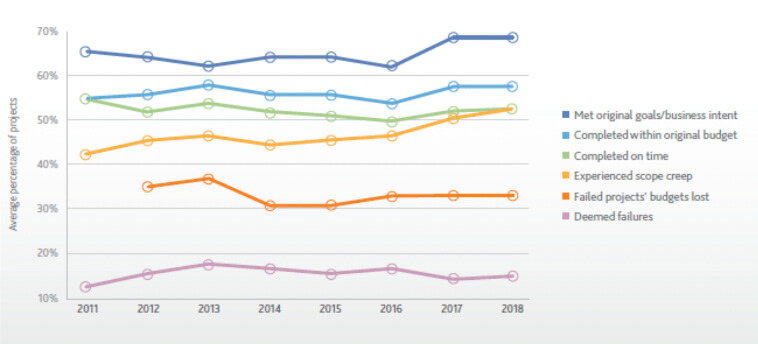
The larger and more complex the project, often the poorer the record of success. Figure 1 (below) from the Project Management Institute (PMI)1 indicates that less than 60% of all projects are completed on time and within the original budget. This has remained consistent over many years, as has the deemed failure rate of around 15%.
Most large and many smaller companies have well developed and detailed project systems, processes, policies and procedures. Every task, step and phase can be described in detail and tracked on spreadsheets, charts and graphs through stage gates requiring multiple levels of authentication and approval. Project tools are also scalable so that simpler versions can be used for smaller, less complex projects. Larger projects usually have many moving parts and run over long periods. Therefore, the potential for changes to internal and external environments impacting the original plan, goals, scope and budget is increased.
If the technology, processes, policies and procedures to track and guide a project from beginning to end are so detailed then why the high incidence of cost and time overrun?
The people delivering the project – their behaviours and style of response to situations and challenges, the culture they build and relationships they nurture are critical to project success. As Charles R Swindoll said “Life is 10% of what happens to you and 90% of how you react to it”.
In other words, having the best systems and processes will support in addressing technical issues, but will only get you so far. Project teams are made up of and led by people, all working for and/or addressing the needs of a broad cross-section of stakeholders such as owners, workers, contractors, joint venturers, communities, governments and other interested parties. Many of these groups can have diverse views reflecting conflicting needs, interests and pressures.
Rising Above or Falling Below
As a senior executive, project manager or leader of a team within a project, how you react, the behaviours you exhibit and the actions you take have the potential to positively or negatively impact your project. The more senior you are and the greater the leadership role (power) you have, the more significant that impact will be.
Depending on the size and complexity of the project there can be an almost infinite number of reasons that can impact project scope, time and cost, all of which need to be continually managed.
When faced with a situation or challenge regarding your project, your effectiveness in dealing with it will be determined by:
- How you engage with the situation/challenge – your (emotional) reaction to it and how this impacts your behaviours and interactions, the decisions you make and actions you take.
- How you perceive the situation/challenge – whose needs you are seeing, valuing and prioritising (self/others).
Each of these is a continuum reflecting your level of consciousness at a point in time. Depending on where you sit on each of these continuums will determine one of three positions – staying stuck, rising above or falling below.
Staying stuck (freeze) rarely happens for any length of time when involved in a project due to the pressures from all around to act. The larger and more costly the delays, the greater this pressure becomes. Either you will propel yourself into action or others will.
Rising above involves moving into acceptance. Accepting the situation (what is) requires accepting both your emotional response to it and the rights of others to have/hold their views and reactions, even if you don’t agree with them. By accepting the legitimacy of others having their viewpoint, you are then able to discern the most constructive way of responding. Sometimes this may be to realise that their viewpoint expands or changes your own. At other times, it may mean accepting that while you believe you have a greater or more accurate grasp, you will none-the-less need to incorporate and work with their input (particularly if they have the formal/structural power) to find the most optimal way forward.
If you are not prepared to get out of the situation and can’t change the situation (it’s outside of your control), your only option is to accept the situation. If you can’t or won’t accept it then you will likely fall below – to any of the following three states:
- Victim (Flight) – sadness/powerlessness/depression.
- Persecutor (Fight) – anger/resentment/retaliation.
- Rescuer – denial/avoidance/dependency.
Each of these will be reflected by some form of duality thinking – good/bad, right/wrong, win/lose – and the consequent actions that result.
By accepting the situation, you are not necessarily changing it, you are changing your relationship to it. Accepting the situation doesn’t mean you have to like it or approve of it. Accepting means you are rising above, empowering yourself (and others) by providing the opportunity to “observe” the situation, negating the influence of defensive emotion and seeing possibilities for overcoming impasse in order to move forward. Accepting the situation also means you are prepared to understand, value and (as appropriate) prioritise others’ needs alongside your own by considering what the situation is like for them.
How might this look?
Let’s look at a couple of (simplified) project leadership scenarios.
Scenario 1 – after many weeks/months of planning, investigation and discussion with internal and external stakeholders, a project plan and budget is presented to management (or joint venture partners etc) for approval. The plan is approved however due to internal budgetary constraints you are asked to complete the project for 20% less.
What internal process do you go through? Do you:
Fall Below – into persecutor. “We spent all this time and effort so we know what it will take” – “we are right, they are wrong, either it costs $x or it can’t be done”. “Well if finance didn’t have 50 people charging to my cost code we would be better off”. “If HSE was reasonable on their advisor/site personnel ratio we wouldn’t be in this position”. “What would they know, we’re the experts”. “I’ll show them, we’ll make some changes however when it costs what we said it would they’ll see we were right all along”. “I’ll make finance and HSE absorb the cost cuts” – etc.
Fall Below – into victim. “This could reflect poorly on me”. “What will my team think”. “What happens to my career if I can’t deliver on this”. “How could they do this to me”. “This always happens – our processes are no good, the company doesn’t care about its people”. “Why couldn’t they have flagged this earlier then we could have addressed it before it got to the approval stage” – etc.
Fall Below – into rescuer. “How can I protect the team”. “Do they need to know – perhaps we can get through this, I’ll act like it didn’t happen and that all is ok”. “Let’s keep it to ourselves so we don’t spook the other stakeholders”. “How can we use the contingency or other assumptions to mask the reduction” – etc.
Or do/can you respond by:
Rising Above – into acceptance. “Ok not what I would have preferred”. “I don’t like it but I don’t have to like it”. “Let’s sit down and see what we can do differently”. “How do I engage people (stakeholders) around the new paradigm”. “How do we work together to be successful whilst clearly outlining the additional risks, challenges and potential impacts that this may have”. “How do we make constructive meaning of this for everyone – what new opportunities does it present”. “I wonder what is happening for them (management/joint venture) and what is driving this decision,what insights does this give me – who can I talk to and gain a greater understanding of what’s going on” – etc.
Scenario 2 – Part of the way through the project there is a major safety incident. A decision needs to be made whether to shut down part of or the entire site/activity until the incident cause is identified and measures are taken to ensure/minimise the chance of a recurrence.
What internal process do you go through? Do you:
Fall Below – into persecutor. “I’m going to shut down the site and as it’s the contractors fault they will pay”. “They (and any subcontractors) can absorb the cost (or I’ll replace them) so it won’t impact my/our bottom line”. “Either we shut down the entire site and the project cost/time blows out or we don’t – it’s a simple as that”. “It’s the contractor’s fault, they caused the incident. All they give is lip service to HSE, their only interest is in making money”. “If the executive team/joint venture ask questions I’ll/we’ll lay the blame exactly where it belongs (which isn’t me/us) so our reputations don’t suffer”– etc.
Fall Below – into victim. “This reflects badly on me”. “If this goes pear-shaped, I may never get another chance”. “I don’t know what to do”. “Why does this keep happening”. “If there was proper training and procedures this wouldn’t have happened”. “This is going to throw us way behind in our schedule and budget – we won’t be able to deliver on time now” – etc.
Fall Below – into rescuer. “It’s ok, these things happen, how can I help?”. “How can I fix this for you, what do you need from me?” “It’s not that bad, let’s not compromise the project by turning over too many rocks or opening a Pandora’s box of unrelated issues – we’ll just hope it goes well from here without further incidents”.
Or do/can you respond by:
Rising Above – into acceptance. “Ok it’s happened – it could have been much worse so it’s good we caught it when we did”. “What options (if any) do we have”. “Let’s sit with our stakeholders and see what these are”. “What do we need to do to effectively make meaning of any changes for the team who will be impacted”. “I wonder what is happening for our contractors around this/what are the impacts likely to be for them”. “How do we best collaborate to get back on track”. “What can we learn from this and how do we use these learnings moving forward”– etc.
If you have the power, falling into persecutor can be an easy out and may get your needs met initially however at what present or future cost? The quicker you can move to acceptance and communicate, engage and act from this position, the more positive will be the impact on team culture and the project in general.
Whilst you may feel that one leader (particularly in a large project) can’t make a significant difference, by moving into acceptance you are demonstrating to others within your team, other teams, contractors and other stakeholders how to be different. By accepting the new situation, the environment surrounding it, what is happening and your feelings about it, you will free yourself to shift into a more constructive personal mindset and thereby increase the likelihood of determining a better way forward. By seeking to understand what it is like for others and being open to considering, valuing and accepting their views, new opportunities for strengthening relationships and collaborating more effectively will become apparent.
While many of us can move towards a state of acceptance given the passage of time and the weakening of intensity of our initial emotional responses (because we must), getting there quickly, consistently and sustainably is the key – and that’s more challenging. This is because moving to acceptance is not primarily a mental process. You can’t get there just by thinking about it. Rising above your emotional reaction to a situation/challenge involves recognising, owning and reflecting upon the reaction in order to understand what underpins it. I will explore this further another time.
Conclusion
Projects rely on people to be successful. The best systems, processes, policies and procedures, whilst important will only get you so far. Becoming aware of and managing your emotions, the behaviours that result, the decisions you make and the actions you take, is critical. As is the scope of your capacity to see any situation/challenge from others’ perspectives, acknowledging their right to have/hold the views they have and valuing/prioritising their needs as much as your own. The greater the leadership authority (and therefore the formal power accorded to you), the more important these skills become.
Whatever situation or challenge you are dealing with in your project is less important than how you react to it – whether you stay stuck, fall below or rise above. The most effective reaction is rise above it, to acceptance. Acceptance is an attitude not an action, it is not about being passive or avoiding/ignoring emotion. It is about rising above to “observe” the situation holistically, observing and embracing your reactions and doing the internal work to transcend them and negate the influence of defensive emotion.
Most importantly acceptance is a choice you make in how you want to be. Acceptance doesn’t mean you have to like something or that you stop looking for ways to change the situation/challenge. It allows you to increase your perspective and see possibilities for overcoming impasse (win/lose) dynamics so as to move forward in constructive ways that may not have previously been apparent – to do different.
References
Join the Turquoise Alliance
Receive our latest news, articles and events delivered to your inbox.

Company Purpose – Shareholder Worth and/or Social Responsibility

A Case for Change – Why as Leaders We Need to BE Different to DO Different.